 Akila Apart City
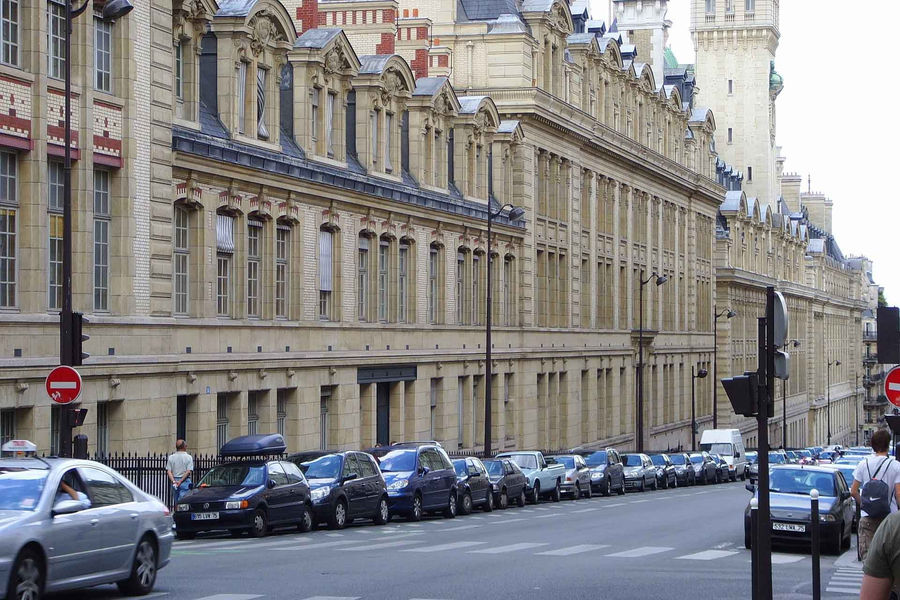
They call it a mountain; it tops out at sixty-one metres. But it was on this bump of the Left Bank that the University of Paris was born in the twelfth century, and that the quarter took the name of the language spoken in it. Here is enough to read the streets.
Geneviève, and why the hill carries her name
In 451 Attila's Huns marched on Paris. The population wanted to flee. A young woman from Nanterre, Geneviève, persuaded Parisians to stay and pray. Attila bypassed the city and turned towards Orléans. Paris was spared, and Geneviève became its patron saint.
She was buried on this hill, in a basilica built by Clovis, who was buried there himself. The abbey of Sainte-Geneviève grew around the tomb for thirteen centuries, drawing pilgrims, schools and builders. It was demolished after the Revolution. All that survives is the bell tower, the Clovis tower, visible from rue Clovis over the wall of the Lycée Henri-IV, which was built in the old abbey buildings.
A university born out of a strike
By the twelfth century the cathedral schools of Notre-Dame had grown too cramped and too closely watched. Masters crossed to the Left Bank and taught freely, outdoors or in rented rooms, on rue du Fouarre — so called because students sat on straw, feurre.
Around 1200 these masters formed a guild: the universitas magistrorum et scholarium, the community of masters and students. The University of Paris had no campus and would not have one for centuries. It was an organisation, not a place. It won privileges from the king and then the pope, including exemption from ordinary justice and the right to strike. It used both liberally.
Teaching was in Latin, which is where the quarter's name comes from. Students came from across Europe and grouped themselves into "nations": France, Picardy, Normandy, England-Germany.
The colleges: where students slept
Students were poor and the city expensive. From the thirteenth century, charitable foundations opened houses to lodge and feed them: the colleges. Beware the false friend: no teaching took place in them, at least at first. They were halls of residence.
More than fifty stood on the hill. In 1253 Robert de Sorbon, chaplain to Saint Louis, founded one for sixteen poor theologians. His name stuck. In 1394 Pierre Fortet, a canon of Notre-Dame, founded another on rue Valette, of which a tower survives.
The Revolution abolished them all. Their buildings were sold, demolished or turned into lycées. But the names stayed in the streets: rue des Carmes, rue de Lanneau, rue Valette. And fragments survive in private courtyards, glimpsed through a carriage door left briefly open.
The Sorbonne as you see it
Robert de Sorbon's college became over the centuries the faculty of theology, then the symbol of the University itself. Richelieu, who was its provost, had it rebuilt in the seventeenth century and raised a chapel by Jacques Lemercier, where he is buried under a tomb by Girardon. That chapel is the only old part still standing.
The rest dates from the Third Republic. Between 1885 and 1901 the architect Henri-Paul Nénot levelled and rebuilt the whole in a neo-Renaissance style, around the great lecture hall and its Puvis de Chavannes fresco, The Sacred Wood. That is the Sorbonne, massive and solemn, that gets photographed from place de la Sorbonne.
The square, with its lime trees, fountain and terraces, is one of the best places in the quarter to sit. The interior opens only on heritage days or for organised guided tours.
Saint-Étienne-du-Mont, the quarter's treasure
Just behind the Panthéon, an odd façade stacking a classical pediment, a Gothic rose window and a lopsided bell tower. It was built between 1492 and 1626 and carries the mark of every decade.
Inside is the rarest thing in Paris: the city's last rood screen. A rood screen is a stone gallery that in the Middle Ages separated the choir, reserved for clergy, from the nave where the congregation stood. Almost all were destroyed in the seventeenth and eighteenth centuries to "open up the view". This one, carved around 1530, survived. It crosses the nave in a single flattened arch, with two spiral staircases whose balustrades are pierced like lace. It is spectacular, and it is free.
The church also holds the shrine of Sainte Geneviève, which still receives pilgrims, and the tombs of Blaise Pascal and Jean Racine, marked by slabs in the floor near the choir.
Film enthusiasts will recognise the steps on rue de la Montagne-Sainte-Geneviève beside the church: it is there that a 1920s Peugeot collects the hero at midnight in Midnight in Paris.
A one-hour walk
On foot, starting at the bottom.
- Place Maubert, once a site of open-air teaching, now a market three mornings a week.
- Rue de Lanneau and rue Jean-de-Beauvais, two of the most medieval streets in the quarter, with the chapel of the Collège de Beauvais.
- Rue Valette, climbing to the Panthéon; at number 21, the courtyard of the Collège de Fortet and its tower.
- Place du Panthéon, the Bibliothèque Sainte-Geneviève, the Clovis tower.
- Saint-Étienne-du-Mont and its rood screen.
- Rue Descartes and then place de la Contrescarpe, where the quarter becomes a village again.
Frequently asked questions
Can you visit the Sorbonne?
Not freely. Access is by European Heritage Days or organised guided tours. The square and the façade are always open to view.
What is a rood screen?
A stone gallery separating the clergy's choir from the congregation's nave, from which the Gospel was read. The one at Saint-Étienne-du-Mont, from around 1530, is the only one left in Paris.
Why is it called the Latin Quarter?
Because university teaching was given in Latin and students spoke it to each other in the street, right up to the Revolution.
Where is Sainte Geneviève buried?
Her shrine is in Saint-Étienne-du-Mont. Her original tomb was in the neighbouring abbey, destroyed after the Revolution; her relics were burned in 1793 and only a part was saved.
Are any medieval colleges still visible?
Very little: the Collège de Fortet tower on rue Valette, the Collège de Beauvais chapel on rue Jean-de-Beauvais, and fragments of wall in private courtyards.