 Akila Apart City
Everything that follows fits in a rectangle one kilometre by eight hundred metres. You can cover it without once taking public transport, and that is the point: the Latin Quarter makes sense on foot, because its streets still follow the contours and the plan of the Middle Ages.
9am – The Panthéon and its square
Start at the top while your legs are fresh. The place du Panthéon opens onto four buildings that sum up the quarter: the monument, the Bibliothèque Sainte-Geneviève, the law faculty and the town hall of the 5th.
Go into the Panthéon at opening, ahead of the groups. Allow an hour for the nave, Foucault's pendulum and the crypt. If the colonnade is open and the sky clear, climb: it is the best overview in Paris for understanding where you are.
10.30am – Saint-Étienne-du-Mont
Thirty metres behind the Panthéon. Go in for the rood screen, the only one left in Paris, with its two spiral stairs. Sainte Geneviève's shrine is in the right aisle; Pascal and Racine lie near the choir.
On the way out, take the steps on rue de la Montagne-Sainte-Geneviève to the left, then rue Descartes. At number 39, the Verlaine plaque. You are now heading down to the Contrescarpe.
11am – The Contrescarpe and rue Mouffetard
Cross the square and walk down the Mouffetard to the bottom. Do not stop in the first hundred metres: the real quarter starts after rue de l'Épée-de-Bois, where the shops become shops again.
Buy lunch from the traders at the bottom of the street. It is the cheapest and the truest way to eat in this quarter.
12.30pm – The Roman arena, for lunch
Walk three hundred metres up rue Monge. The arena entrance is at number 49, through a passage that is easy to miss. Sit on the Roman tiers and eat there while Parisians play boules in the arena.
It is one of the few places in Paris where you can picnic inside an ancient monument with no ticket and no barrier.
With an extra hour, the Jardin des Plantes is five minutes east, and the Grande Mosquée next door, with its patio and tea room.
2.30pm – Cluny, the baths and the unicorn
Head north-west along rue des Écoles. The Musée de Cluny is at the corner of boulevard Saint-Michel.
An hour is enough if you aim: the Roman frigidarium with its fourteen-metre vault, the heads of the kings of Judah from Notre-Dame, and the Lady and the Unicorn room. Take your time over the six tapestries; they are what you came for.
Coming out, place de la Sorbonne is two minutes away, for a coffee under the lime trees.
4pm – The quays and Shakespeare and Company
Walk down boulevard Saint-Michel to the Seine, then turn right along the quay. The bouquinistes' boxes are open at this hour.
Detour through square René-Viviani for the 1601 false acacia, the oldest tree in the city, then Saint-Julien-le-Pauvre, then Shakespeare and Company at 37 rue de la Bûcherie. Go upstairs.
Across the arm of the Seine, Notre-Dame. The view from the quai de Montebello is the best from the south side.
5.30pm – The Luxembourg, to finish
Climb back up boulevard Saint-Michel, or better, rue Saint-Jacques, which is the old Roman cardo and rises less sharply than it looks.
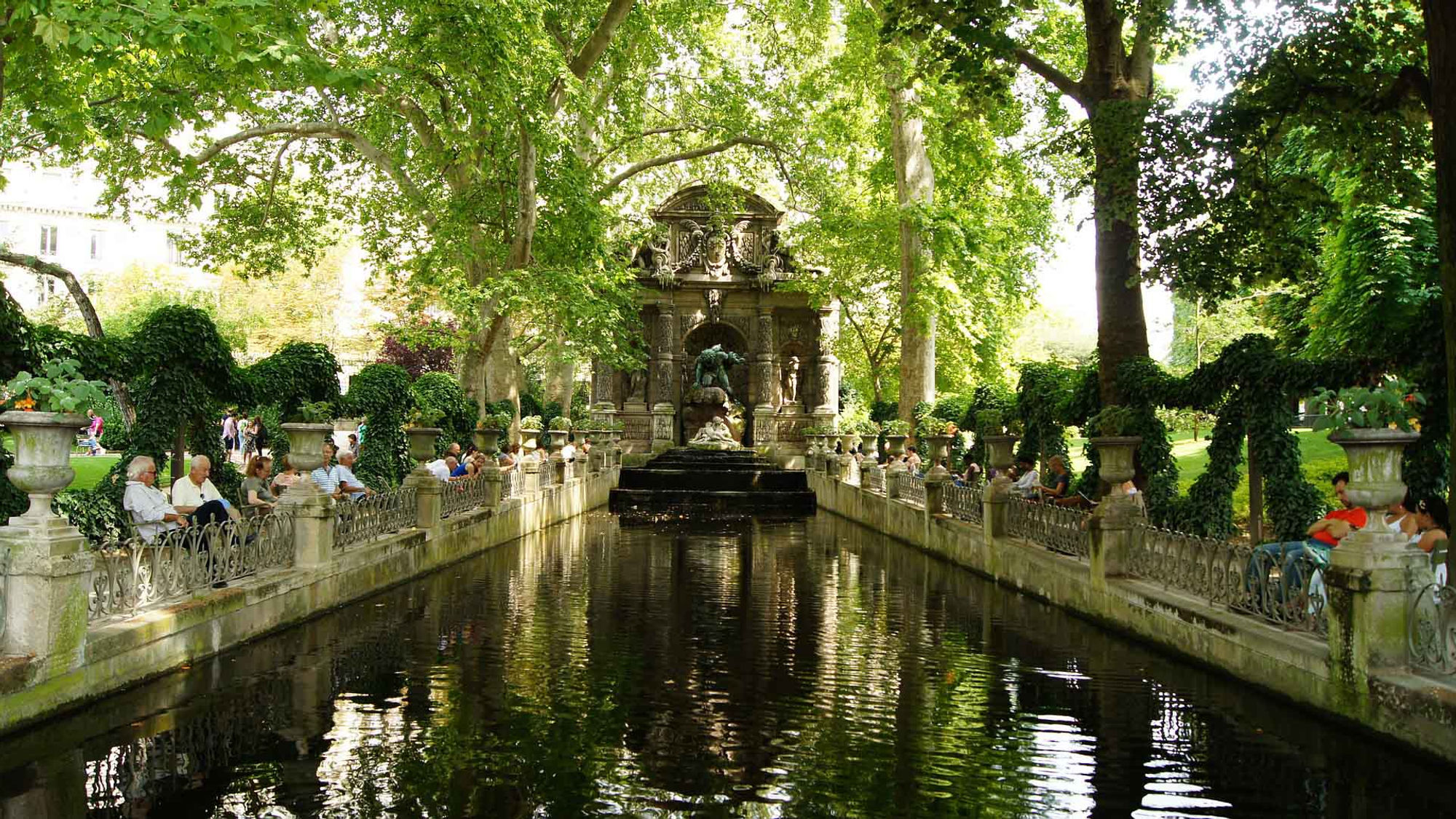
Enter the Luxembourg Gardens and go straight to the Medici Fountain on the eastern flank of the palace: at this hour the light comes flat down the water walk and it is the best moment of the day to see it.
Finish on a chair by the main basin. The guards whistle fifteen minutes before closing.
Practical notes
- Total distance: about six kilometres, with two serious climbs. Flat shoes are essential, the cobbles are uneven.
- Tickets: the Panthéon and Cluny can be booked online in advance, which is advisable in season. The arena, Saint-Étienne-du-Mont, the quays and the Luxembourg are free.
- Closing days: many museums close on Monday or Tuesday. Check before fixing your day.
- Wet-weather variant: replace the arena and the Mouffetard with the Grande Galerie de l'Évolution at the Jardin des Plantes, which is worth two hours on its own.
Frequently asked questions
How long do you need for the Latin Quarter?
A full day covers the essentials on foot. Two days let you add the Jardin des Plantes, the Grande Mosquée and the Cluny museum without rushing.
Does this route work with children?
Yes, by swapping Cluny for the Grande Galerie de l'Évolution and allowing a stop at the Luxembourg, where there are sailing boats, puppets and playgrounds.
What is the best day?
A weekday other than Monday, since several museums close then. Sunday morning, on the other hand, is the best time for rue Mouffetard.
Is a museum pass worth it?
Only if you visit more than three or four paid sites in the following days. For this day, two tickets are enough.