 Akila Apart City
The quarter has a quality its residents stop noticing: it already looks like a set. No towers, no glass, cobbles, eighteenth-century façades and a hill. Directors worked that out long ago.
La Boum, 1980: the school and the corner of the Panthéon
Claude Pinoteau shot La Boum in the autumn of 1980. Sophie Marceau was thirteen and had never acted. The film drew more than four million admissions in France, and for a whole European generation it remained the film of adolescence.
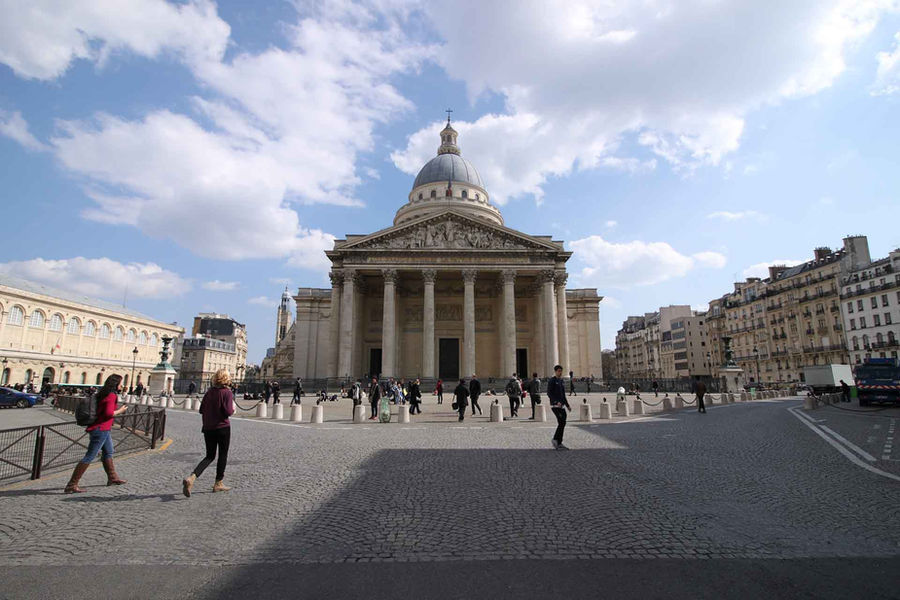
Vic's school is the Lycée Henri-IV, 23 rue Clovis, in the 5th. You recognise it by its long façade and its railings. It is in front of it, and in a corner of the Panthéon on the place Sainte-Geneviève side, that the scene is shot in which two boys on motorbikes approach the two girls talking on the pavement.
The choice is not neutral: Henri-IV occupies the buildings of the former abbey of Sainte-Geneviève, whose Clovis tower, an eleventh-century Romanesque belfry, still rises above the wall. A film about 1980s schoolchildren was therefore shot in a medieval monastery, fifty metres from the tomb of the Republic's great men. Nobody notices on screen, which is as it should be.
The rest of the film scatters across Paris: the roller-skating club at the porte de Champerret, the brasserie La Coupole in Montparnasse, the Pagode cinema on rue de Babylone, Versailles.
Midnight in Paris, 2011: the steps at place de l'Abbé-Basset
In Woody Allen's film, Gil, a blocked American writer, sits down on some steps at midnight. A 1920s Peugeot pulls up, revellers invite him in, and he wakes up in Fitzgerald's company.
The steps exist. They are at place de l'Abbé-Basset, a tiny corner on the flank of Saint-Étienne-du-Mont, where it meets rue de la Montagne-Sainte-Geneviève. Thirty seconds from the Panthéon.
It is one of the rare cases of a filming location becoming an attraction: visitors sit there for the photograph, sometimes at midnight. Residents have mixed feelings, understandably.
The choice of setting is sound: the little square is a crossroads of periods. Behind it, a church begun Gothic and finished classical. Opposite, a street on a medieval line. At the end, a neoclassical monument. Allen wanted somewhere several centuries share a single frame; he found it thirty metres from the Panthéon.
Before Sunset, 2004: the bookshop
Richard Linklater's film opens in an English-language bookshop in Paris where Jesse is presenting his novel. It is Shakespeare and Company, rue de la Bûcherie, facing Notre-Dame, with shelves to the ceiling and beds between the books.
The rest of the film is a walk: the quays, a café, a river boat, a courtyard. It runs in real time, eighty minutes of film for eighty minutes of story, which is very rare. The Latin Quarter suits it because it is one of the few parts of Paris where two people can walk for an hour without taking transport or crossing an avenue.
The screens: three cinemas in a hundred-metre street
The quarter does not only get filmed, it projects. Rue Champollion, between place de la Sorbonne and rue des Écoles, holds three art-house cinemas along about a hundred metres. Rue des Écoles adds more.
They programme retrospectives all year, in the original language: a Kurosawa season, a complete Rohmer, a Wednesday classic, restored prints. No other Paris district comes close, and the reason is simple: students.
The model is fragile. Several historic screens on boulevard Saint-Michel and rue Monsieur-le-Prince have closed since the 1990s. The survivors live on a loyal audience and on the absence of anywhere else to see a 1953 film on a large screen.
A local habit: look at the poster before going in, not the timetable. In these cinemas people often walk into a film they have never heard of.
Why they film here
Three reasons, none of them romantic.
The quarter was never cut through. Haussmann drove boulevard Saint-Germain and boulevard Saint-Michel through it and then stopped. The medieval fabric behind is intact. A shot of rue de Lanneau or rue Jean-de-Beauvais can pass for any period between 1600 and now, if the frame is tight.
There is relief. Paris is flat; the Montagne Sainte-Geneviève is one of the few slopes in the centre. A staircase, a climbing street, a view closed by a monument: gifts for a cinematographer.
It is alive without being saturated. You can film here without closing an avenue, unlike the Champs-Élysées or the Marais at a weekend.
Frequently asked questions
Where was the school in La Boum filmed?
At the Lycée Henri-IV, 23 rue Clovis in the 5th arrondissement, and in a corner of the Panthéon on the place Sainte-Geneviève side for the motorbike scene.
Where are the Midnight in Paris steps?
At place de l'Abbé-Basset, on the flank of Saint-Étienne-du-Mont where it meets rue de la Montagne-Sainte-Geneviève, two minutes from the Panthéon.
Can you visit the Lycée Henri-IV?
No, it is a working school. The Clovis tower, a fragment of the abbey of Sainte-Geneviève, can be seen from rue Clovis over the wall.
Which art-house cinemas are in the Latin Quarter?
They cluster on rue Champollion and rue des Écoles, programming retrospectives and restored prints in the original language all year.