 Akila Apart City
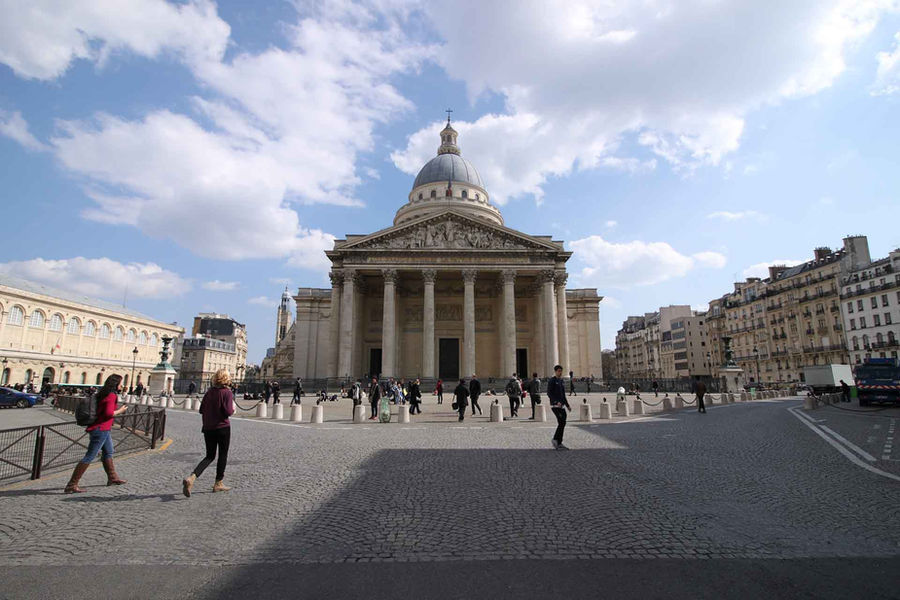
From rue Valette you see nothing else. The street climbs straight at its colonnade and stops at its feet. It is a building that changed religion three times, changed name twice, and ended up housing the closest thing a republic has to a holy place: the tomb of its great men and women.
A sick king's vow
In 1744 Louis XV fell gravely ill at Metz. He vowed that if he recovered he would rebuild the abbey of Sainte-Geneviève, then in ruins, which had watched over the patron saint of Paris since the sixth century. He recovered. He kept his word with the delay befitting a king: the first stone was laid twenty years later, in 1764.
The architect was Jacques-Germain Soufflot, back from Italy where he had been among the first Frenchmen to survey the temples at Paestum. His idea was ambitious to the point of provocation: marry the clarity of a Greek temple to the lightness of a Gothic cathedral. Columns, a pediment, and a dome resting on four piers kept as slender as possible.
The calculation was too fine. Cracks appeared in the piers during the 1770s and a public quarrel set Soufflot against his critics. He died in 1780 without seeing the dome closed; his pupil Jean-Baptiste Rondelet finished the building in 1790 by strengthening the supports. The church was ready to be consecrated at precisely the moment France stopped wanting one.
A temple without a god
In April 1791 Mirabeau died. The Constituent Assembly, looking for somewhere to bury him, decreed that the church of Sainte-Geneviève would receive "the ashes of the great men of the era of French liberty". Across the pediment they carved the line still there: Aux grands hommes, la patrie reconnaissante — to the great men, from a grateful homeland.
Mirabeau went in, then came out three years later when his correspondence with the court was discovered. Voltaire arrived in 1791, Rousseau in 1794, and two lifelong enemies ended up facing each other in the crypt, which escaped nobody.
The nineteenth century could not decide. Church under Napoleon, church under the Restoration, temple under the July Monarchy, church again under the Second Empire. The pendulum swung until 1885, when Victor Hugo's death and a funeral that drew an enormous crowd settled it for good. The Panthéon has been a civil monument ever since.
The pendulum that turned the Earth
In 1851 the physicist Léon Foucault hung a 28-kilo sphere from a 67-metre wire under the dome and set it swinging. Hour after hour the plane of oscillation shifted slowly to the right.
The demonstration is wholly elegant: the pendulum does not turn. The ground turns beneath it. For the first time the rotation of the Earth became visible to the naked eye, indoors, with no instrument and no astronomy. Foucault had first tried the experiment at home, then at the Observatory, before securing the Panthéon and the height under its dome.
A pendulum still swings in the same spot. It is not the 1851 one, whose original sphere is kept at the Musée des Arts et Métiers, but the principle and the spectacle are the same. You can stand for twenty minutes watching it step its path round one notch, then another.
Who lies in the crypt
Around eighty people. The crypt is wide, low, vaulted and far quieter than the nave.
Voltaire and Rousseau face each other. Victor Hugo, Émile Zola and Alexandre Dumas share a vault. Jean Jaurès, assassinated in 1914, was transferred in 1924. Jean Moulin entered in 1964, to a speech by André Malraux that is still replayed. Louis Braille is there, and Malraux himself.
Women arrived late and slowly. Sophie Berthelot was admitted in 1907, but as a wife, so the couple would not be separated. Not until 1995 did Marie Curie enter on the strength of her own work. Then the Resistance members Germaine Tillion and Geneviève de Gaulle-Anthonioz in 2015. Simone Veil in 2018, with her husband. Joséphine Baker in 2021, the first Black woman admitted, under a cenotaph since she rests in Monaco. Missak Manouchian and his wife Mélinée in 2024.
Entry to the Panthéon is not an ordinary burial: it is decided by the President of the Republic, and the body sometimes stays elsewhere. The tomb is then a cenotaph, an empty one.
What to see, and in what order
The nave. Look up as you walk in: the inner dome is pierced by an oculus revealing a second painted dome above it. Soufflot nested three domes inside one another to lighten the whole. It is his tour de force.
The Puvis de Chavannes paintings. On the right-hand wall as you enter, the cycle devoted to Sainte Geneviève. The last scene, Sainte Geneviève watching over Paris, shows the old woman on a rampart with the sleeping city below. It is one of the finest things in the building and almost nobody stops in front of it.
The pendulum, at the crossing.
The crypt, by the stairs to the right of the choir.
The colonnade, up top, open part of the year. Seventy metres above the ground, and one of the most complete views of Paris: the Luxembourg and the Eiffel Tower one way, Notre-Dame and the Seine the other, Montmartre beyond. The climb is up a narrow stair and the panorama is worth it.
Opening hours and access to the colonnade vary with the season and the weather. Check before coming; the climb closes in high wind.
What is around it, three minutes on foot
The place du Panthéon is a plateau ringed by buildings each worth a look.
- Saint-Étienne-du-Mont, behind and to the left. Sainte Geneviève's church, and the only surviving rood screen in Paris.
- The Bibliothèque Sainte-Geneviève, opposite, by Henri Labrouste. Its 1850 reading room with an exposed iron frame is one of the finest French interiors of the century.
- The town hall of the 5th and the law faculty, closing the square.
- The Lycée Henri-IV, from which the Clovis tower, an eleventh-century Romanesque bell tower and the last fragment of the abbey, can be seen.
From the square, rue Valette drops back towards rue des Écoles and the Sorbonne. That is the way into the rest of the quarter.
Frequently asked questions
Can you climb the dome of the Panthéon?
Yes, the outer colonnade is open part of the year, by stairs. The climb is suspended in high wind and during some winter periods: check before making the trip.
How many people are buried in the Panthéon?
Around eighty, only a handful of them women. Some have a cenotaph, that is a tomb without a body, as with Joséphine Baker.
Who decides who enters the Panthéon?
The President of the Republic. The decision is political, often preceded by a public campaign, and the ceremony is organised by the state.
Is the pendulum the original?
No. The 1851 sphere is kept at the Musée des Arts et Métiers. The one swinging in the Panthéon is a faithful reconstruction.
How long does a visit take?
An hour for the nave and the crypt, an hour and a half if you climb to the colonnade.