 Akila Apart City
Twenty-three hectares at the end of boulevard Saint-Michel, between the Latin Quarter and Saint-Germain. Parisians come to read, to run, to play chess and to watch children push wooden boats across the basin. Visitors often pass through too quickly and miss its finest piece, hidden behind the palace.
A queen who was homesick
Henri IV was assassinated in 1610. His widow Marie de Médicis, now regent, could no longer bear the Louvre. She was Florentine, she had grown up in the Pitti Palace, and she wanted that architecture back. In 1612 she bought the Duke of Luxembourg's mansion across the Seine and had Salomon de Brosse build a palace that quotes Florence openly: rustication, banded stonework, windows framed in stone.
She commissioned an Italian-style garden at the same time, with terraces, parterres and groves. She did not enjoy it for long: her son Louis XIII exiled her in 1631 and she died in Cologne, ruined.
The palace is now the seat of the French Senate. The garden belongs to the Senate too, which explains something every regular notices: it closes at nightfall, at an hour that changes every month, announced by a guard's whistle. Nobody lingers in the Luxembourg after sunset.
The Medici Fountain
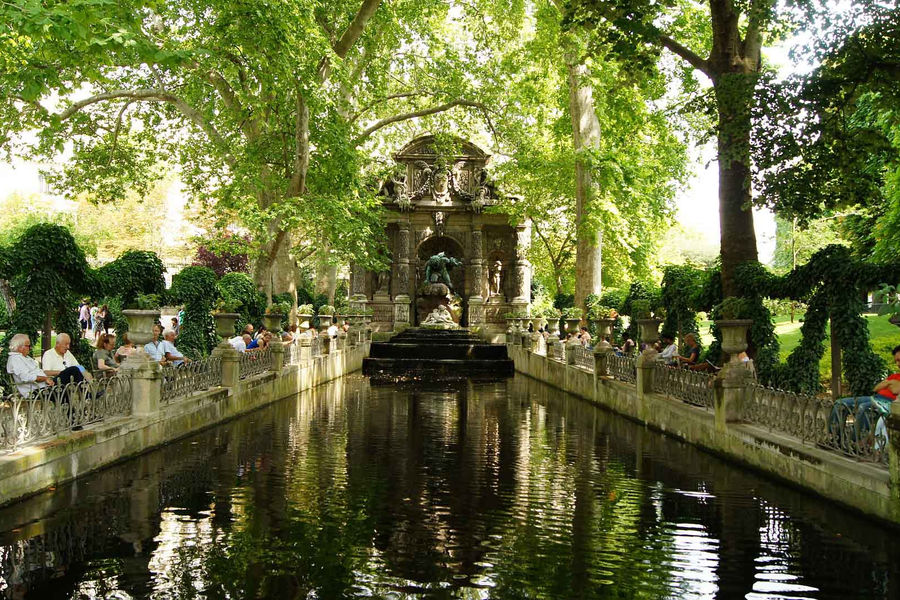
It hides on the eastern flank of the palace, at the end of a long sunken basin lined with plane trees. You can walk past without seeing it, which is exactly what gives it its effect when you do.
It dates from the 1630s and is attributed to Tommaso Francini, the Florentine hydraulic engineer Marie de Médicis brought over. Originally it was a grotto, a rockwork set piece of the kind Italian gardens loved, built against a wall.
It nearly disappeared. In the mid-nineteenth century the new rue de Médicis was to run straight over it. Rather than destroy it, the architect Alphonse de Gisors dismantled it and rebuilt it some thirty metres away in 1862, adding the long basin that gives it today's perspective. The addition is better than the original.
In 1866 Auguste Ottin installed the group now in the central niche: Acis and Galatea surprised by Polyphemus. The two lovers lie in white marble inside the grotto; above them, in black bronze, the crouching cyclops watches. He is about to crush Acis under a boulder. Jealousy has never been better stated in a public garden.
On the back of the fountain, an older relief shows Leda and the swan. It came from another fountain on rue du Regard and was brought here during the move.
The rest of the garden, in order of interest
The octagonal basin in front of the palace, where wooden sailing boats have been hired out since the nineteenth century. Children push them with a stick; it is one of the garden's most durable images.
The statues. There are more than a hundred. The best known series is the queens of France and illustrious women, twenty standing figures around the basin, commissioned by Louis-Philippe in 1843.
The orchard and the apiary. In the south-west corner, a conservation orchard of old apple and pear varieties, and an apiary that has worked since 1856. Beekeeping courses are given there and the Luxembourg honey is sold once a year.
The Orangerie, which over winter shelters palms and orange trees in tubs, some more than two centuries old, and doubles as an exhibition space.
The small Statue of Liberty. A bronze reduction given by Bartholdi. The original went to the Musée d'Orsay in 2012; a copy stands in its place.
The chairs. Green, metal, reclining, free, and you can move them. It is a detail, and it is the difference between a park you pass through and a garden you stay in.
When to go
Early morning, at opening: empty paths, gardeners watering, and flat light down the Medici Fountain walk. It is the best moment by a distance.
Late afternoon, if you come for the atmosphere: chess players under the trees, tennis, the bandstand in summer.
To avoid: a spring Sunday afternoon, when the whole of Paris is there.
The garden closes at dusk, between about 4.30pm in December and 9.30pm in June. Hours are posted at the gates.
Getting there from the Latin Quarter
From the Panthéon, walk down rue Soufflot: it leads straight to the gate, five minutes on a gentle slope. From the Sorbonne, allow seven minutes by rue Victor-Cousin.
By public transport, the RER B station Luxembourg is at the main entrance, which also makes it the easiest arrival point from Charles-de-Gaulle with luggage.
Just to the south, on the same axis, the Observatory Fountain by Davioud and Carpeaux, with its four continents holding up the celestial sphere, is worth the extra three minutes.
Frequently asked questions
Where exactly is the Medici Fountain?
On the eastern flank of the Luxembourg Palace, on the rue de Médicis side. Enter by the rue de Médicis gate and follow the palace: it stands at the end of a long basin lined with plane trees.
Are the Luxembourg Gardens free?
Yes. Only the Musée du Luxembourg and some activities are paid. The garden, its chairs and its paths are free during opening hours.
What time does the garden close?
At dusk, which ranges from about 4.30pm in winter to 9.30pm in summer. Guards blow a whistle fifteen minutes before closing.
Can you sit on the lawns?
Only on certain ones, which are signposted. Most of the formal lawns are off limits, which often surprises visitors.
What is there for children?
The sailing boats on the main basin, the puppet theatre, the playgrounds in the south of the garden and, in season, the ponies.