 Akila Apart City
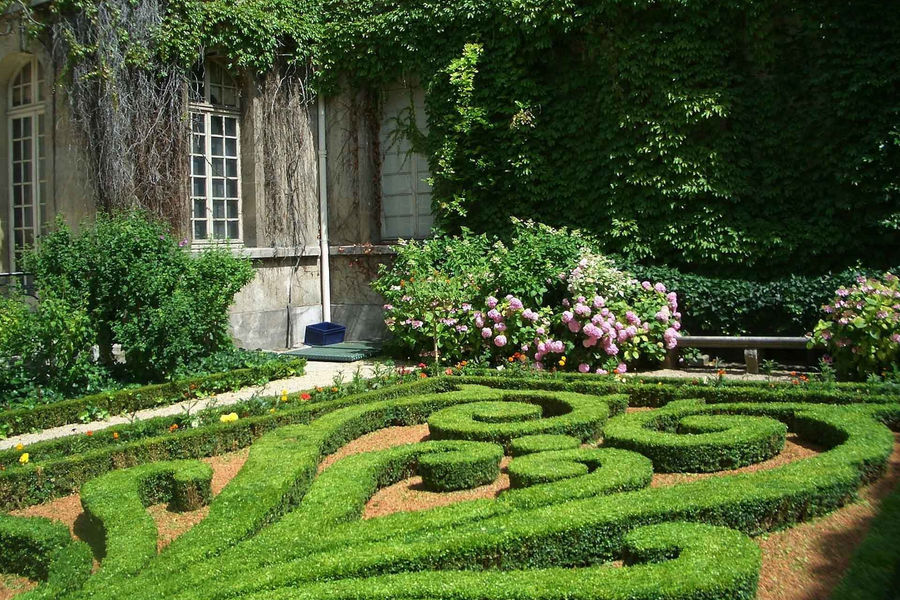
Twenty-eight hectares between the Seine and rue Geoffroy-Saint-Hilaire, ten minutes from rue Mouffetard. You go in to sit down and come out three hours later, because it is a garden, a zoo, four museums and a school at once.
A garden for healing
In 1635 Louis XIII signed the edict creating the Royal Garden of Medicinal Plants. This was not about strolling: it was about growing, studying and teaching the plants that made remedies. Lectures were public, free, and given in French rather than Latin, which scandalised the faculty of medicine.
The garden grew in the eighteenth century under Buffon, naturalist and administrator, who ran it for nearly fifty years. He extended it to the Seine, planted trees from across the world, built the maze, and published his Histoire naturelle, thirty-six volumes that made natural history drawing-room reading.
In 1793 the Convention turned the institution into the Muséum national d'histoire naturelle. It is one of the few revolutionary creations still standing in its original form.
The menagerie, born of a confiscation
In that same year of 1793 private menageries were confiscated, starting with Versailles. The king's animals arrived on foot or by cart. They had to be housed: that is the origin of the menagerie, the oldest zoological park in the world still operating.
Its most famous animal arrived in 1827. A giraffe, a gift from the viceroy of Egypt to Charles X, landed at Marseille and walked to Paris in forty-one days, escorted by the naturalist Geoffroy Saint-Hilaire. Crowds turned out in every village. In Paris tens of thousands came to see her, and she set a fashion in hairstyles, dresses and wallpaper.
The menagerie today is small and old, and makes no apology for it: it specialises in smaller endangered species, and its nineteenth-century buildings, including a rotunda laid out in the shape of the Légion d'honneur cross, are listed.
The Grande Galerie de l'Évolution
Built in 1889 for the Universal Exhibition as a zoology gallery, it closed in 1965 for want of upkeep and stood abandoned for nearly thirty years. The glass roof leaked and the mounted animals rotted. It reopened in 1994 after a restoration that set a standard.
The approach is spectacular. Instead of rows of cases, a thirty-metre-high nave under glass, and at its centre a caravan of life-size African animals crossing the hall in single file, elephants at the head. The lighting shifts through the visit to simulate day turning to night.
Upstairs, the hall of extinct and endangered species, darker and quieter, holding specimens of animals of which nothing else survives anywhere. It is the strongest part of the museum, and the least cheerful.
With children this is the thing to aim for in the whole quarter, especially in bad weather. Allow two hours.
What to see in the garden itself
- The cedar of Lebanon, planted in 1734 by Bernard de Jussieu. Legend has him carrying it from England in his hat after breaking the pot; it actually came from Kew. It is still there.
- The great glasshouses, including the Art Deco winter garden of the 1930s and the Mexican house, holding a tropical forest and desert plants.
- The school of botany, where some four thousand species are arranged by family on labelled beds. Austere and fascinating.
- The maze and Buffon's gloriette at its summit, one of the oldest metal structures in Paris.
- The Palaeontology gallery, untouched since 1898: hundreds of skeletons in a marching herd, in a hall nobody has modernised. Many prefer it to the Grande Galerie.
Finding your way
The garden is free and open daily. The galleries, the menagerie and the glasshouses are paid, each with its own hours and closing days: check before coming, especially on Tuesdays.
Four entrances: place Valhubert on the Seine side, rue Buffon, rue Geoffroy-Saint-Hilaire and rue Cuvier. The Valhubert entrance gives the finest perspective, with the great alley rising straight towards the Grande Galerie.
Directly opposite the rue Geoffroy-Saint-Hilaire entrance, the Grande Mosquée de Paris and its tea room.
Frequently asked questions
Is the Jardin des Plantes free?
The garden itself is, every day. The Grande Galerie de l'Évolution, the other galleries, the menagerie and the great glasshouses are charged separately.
What is the oldest zoo in the world?
The menagerie of the Jardin des Plantes, opened in 1793 from animals confiscated from private collections, is the oldest zoological park still in operation.
What is there for children?
The Grande Galerie de l'Évolution and its animal caravan, the Palaeontology gallery with its skeletons, and the menagerie. Allow half a day for all three.
What is the oldest tree in the garden?
The cedar of Lebanon planted in 1734 by Bernard de Jussieu, still standing in the maze.