 Akila Apart City
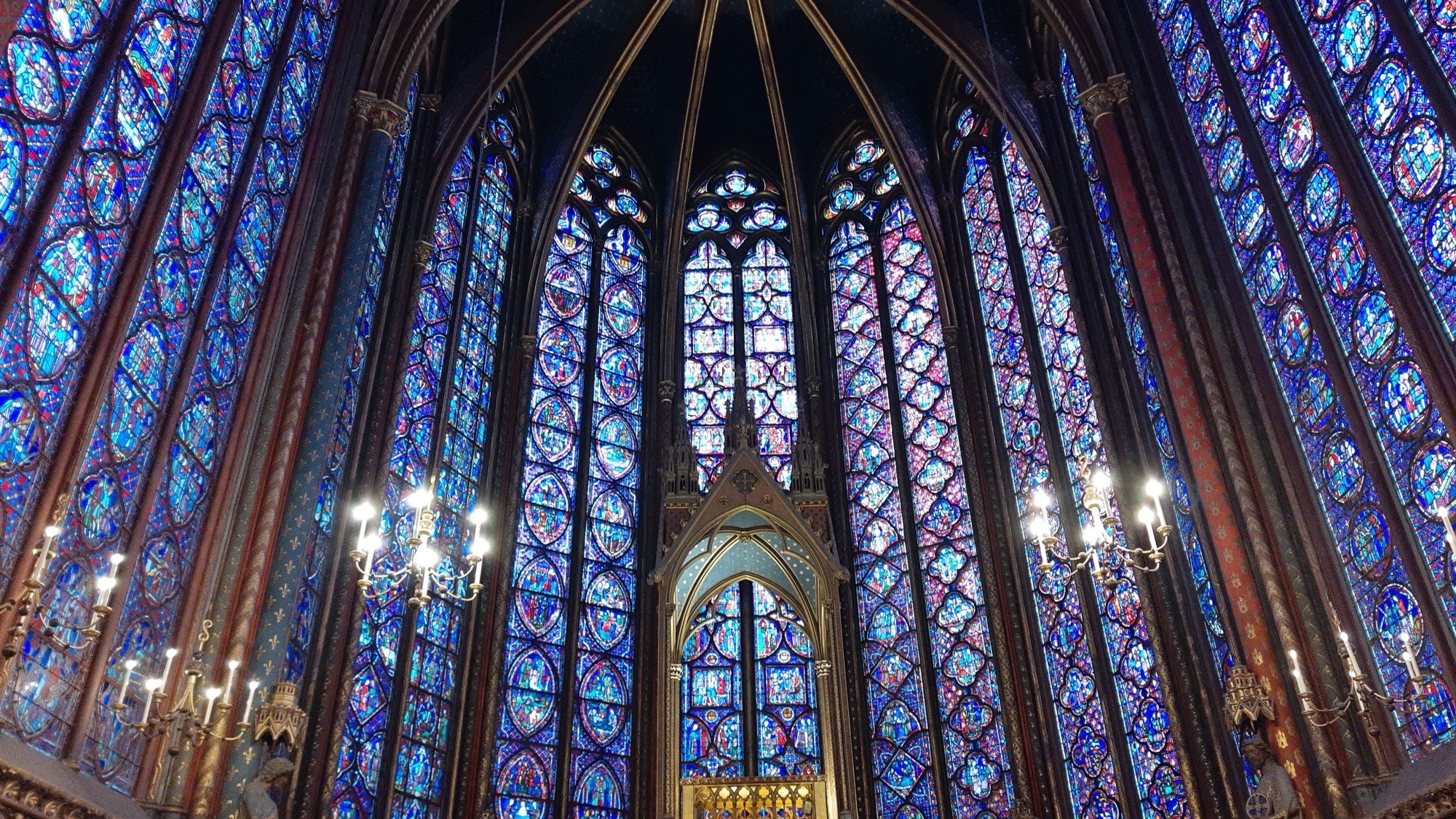
People visit the Sainte-Chapelle for its windows, and they are right to. But it was not built to be beautiful. It was built to contain, and the gap between the box and the jewel says a great deal about what power meant in the thirteenth century.
A crown put up as security
In September 1238 Baldwin II of Courtenay, Latin emperor of Constantinople and short of money, pledged the Holy Crown to a Venetian merchant, Nicolo Quirino.
Louis IX bought it back. The price: 135,000 livres tournois, more than half the annual revenue of the royal domain. This was not expensive piety, it was statecraft. Whoever held the relics of the Passion became, in the eyes of Christendom, the first among Christian kings.
The relic entered Paris on 18 August 1239. The king, barefoot and in a plain tunic, carried it himself on the final stretch. In 1241 he acquired a large piece of the True Cross and seven further Passion relics. In 1242, fragments of the Holy Lance and the Sponge.
Four to six years of building
Now a reliquary on the right scale was needed. Work began between the autumn of 1241 and 1244, at the heart of the palace of the Cité, the king's own residence. It was finished in 1248 and the chapel consecrated that same year. Four to six years for a building of this quality is extraordinarily fast, and it shows: the whole thing has the unity of an object conceived in one go.
Total cost: 40,000 livres tournois. Less than a third of the price of the crown it houses.
The architect's name is unknown. Tradition names Pierre de Montreuil, on no evidence at all.
Two chapels, one above the other: the lower, vaulted at 6.6 metres, for the palace staff; the upper, vaulted at 20.5 metres, reserved for the king and his court, and that is the one people come to see.
Eleven hundred and thirteen scenes
The principle of Rayonnant gothic is pushed here to its limit: the wall disappears. Nothing remains but stone mullions between surfaces of glass, held by external buttresses and iron ties.
Fifteen windows, eight along the sides and seven in the apse. The side windows rise to nearly fifteen metres for four metres seventy wide. Around 615 square metres of glass, and eleven hundred and thirteen scenes, telling the Bible from Genesis through to the arrival of the relics in Paris. The story reads left to right and bottom to top, register by register.
The great western rose is later: flamboyant, built between 1485 and 1495, nine metres across. It tells the Apocalypse. Late in the day, it is the one that catches the sun.
One practical note: come on a clear day, and rather late morning if you want the apse, late afternoon if you want the rose. Under grey skies the chapel is still fine, but it loses the thing it exists for.
What the Revolution made of it
Worship ceased around 1790. The shrines and reliquaries, worth infinitely more than the building, were melted down in 1791 and 1793 for their metal. The relics themselves were scattered, and many disappeared.
The crown of thorns survived. Deposited in the Cabinet des Antiques in 1793 and handed back to the Church in 1804, it is kept today in the treasury of Notre-Dame de Paris.
As for the chapel, in 1797 it became a records store for the law courts. Shelving was set against the windows and part of them was walled up. Paradoxically, that is what saved a great many of them.
Twenty-six years to put it back
In 1836 the State decided to save it and released 600,000 francs. Work began in 1837 and lasted twenty-six years. Félix Duban led it, with Jean-Baptiste Lassus as inspector of works; Lassus took over in 1849, died in 1857, and Émile Bœswillwald finished the job in 1863.
The present spire belongs to that campaign: designed by Lassus in 1850, raised between 1853 and 1855. The original had gone.
The chapel was listed as a historic monument in 1862, and has been on the World Heritage list since 1991 as part of the banks of the Seine.
Some of the glass was remade in the middle of the nineteenth century. Telling the original from the restored takes a specialist's eye, and the question matters less than it seems: what you are looking at is a thirteenth-century object handed down by the nineteenth, and both are part of it.
Getting in without losing an hour
The Sainte-Chapelle sits inside the law courts compound, which means a security check at the entrance. It is that check, not the ticket desk, that makes the queue. Book a time slot, arrive on time, and avoid the middle of the day.
It pairs naturally with the Conciergerie, which occupies the lower part of the same medieval palace and can be visited on a combined ticket. Allow an hour for the chapel, an hour for the Conciergerie.
From the Latin Quarter it is a walk: cross the Seine at the Petit-Pont or the pont Saint-Michel, and you are there.