 Akila Apart City
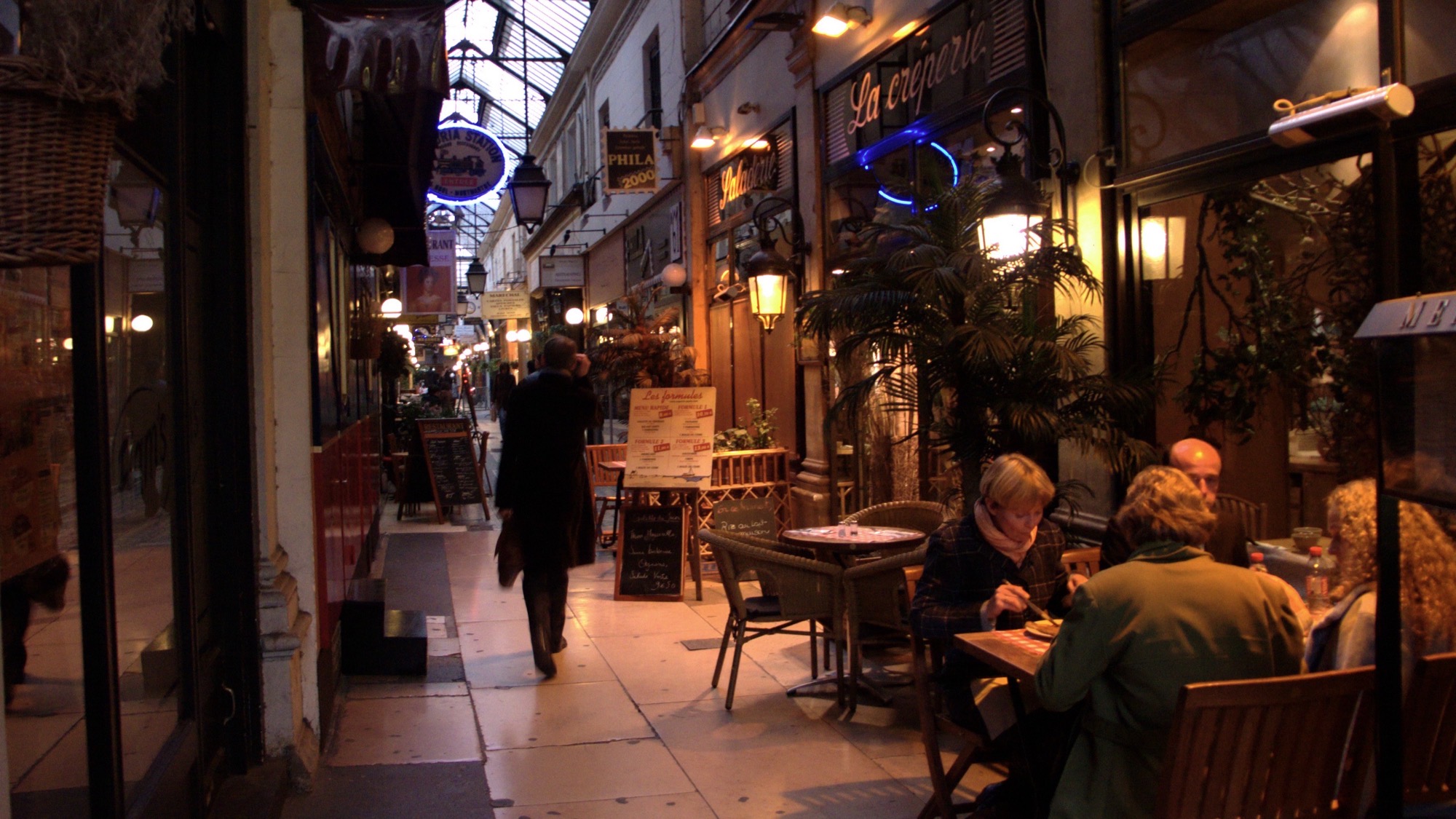
Between the end of the eighteenth century and the start of the Second Empire, developers cut private pedestrian lanes through the blocks of Paris, roofed them in glass and lined them with shops. They are called passages or galleries. They are the direct ancestor of the department store, and enough survive to fill an afternoon.
Why they were cut
The idea is simple and radical: buy two buildings, open a corridor between them, roof it in glass, line it with shops on both sides, and charge the shopkeepers.
What is sold to the passer-by is a street without its drawbacks. Sheltered from the rain, free of carriages, and above all lit from above: the glass roof gives a steady light no ordinary street could offer. People stroll there, which at the time is a novelty.
Almost all of them are on the Right Bank, inside the Paris boundaries of before 1860, and almost all around the Grands Boulevards, where the moneyed crowd moved. That is not an accident of geography, it is a calculation.
The Galerie Vivienne, the best of them
It was built in 1823 for Louis-Auguste Marchoux, president of the chamber of notaries, to plans by the architect Delannoy. It was first called the Galerie Marchoux and took the name Vivienne in 1825.
A hundred and seventy-six metres long and three wide, with a forty-two metre gallery opening onto a rotunda under a glass dome. A neoclassical decor in the Pompeian manner, and on the floor mosaics signed by Giandomenico Facchina, walked over daily by people who never look down.
Its history is not one long success. In 1859 the Marchoux heiress left the gallery to the Institut de France to fund artists. In 1891 a fire killed three people. In 1926 a decree removed it from the historic monuments inventory, leaving it open to demolition. In the 1960s the shops closed one after another, and an artist, Huguette Spengler, bought them to keep the place alive. The revival began around 1980, and in 1986 Jean-Paul Gaultier opened a shop there, which made it fashionable again.
The passage des Panoramas and its branches
The passage des Panoramas is not a corridor but a network: it continues into the galerie des Variétés, the galerie Feydeau, the galerie Saint-Marc and the galerie Montmartre, an ensemble attributed to the architect Victor Grisart.
It is the liveliest of the Paris passages and the least polished. There are stamp and postcard dealers, engravers, and a density of restaurants that makes it a place to have dinner rather than a curiosity to tick off.
Across boulevard Montmartre, the passage Jouffroy continues the walk, and beyond rue de la Grange-Batelière comes the passage Verdeau. Three passages in a row, separated by two boulevard crossings: it is the finest stretch that remains.
What killed them
Paris had up to around thirty covered passages in the 1850s. Then two things happened at once.
Haussmann drove wide avenues through the districts. A passage made sense when the street outside was narrow, filthy and without a pavement; it made far less sense once a thirty-metre boulevard, planted and lit, opened alongside.
And the department store arrived. It took the principle of the passage exactly as it stood, the glass roof, the strolling, the accumulation of shops, but under a single name and at an entirely different scale. The passage had invented the formula, and then had it taken from it.
Most disappeared. Some survive behind gates, closed, inside buildings. A handful remain open to the public, and those are the ones to walk.
An afternoon route
From the Latin Quarter it is about fifteen minutes by metro, line 7 to Bourse or Richelieu-Drouot.
The logical order is to start at the Galerie Vivienne, cross into the Galerie Colbert next door, go down to the passage Choiseul, then walk up the boulevards to the Panoramas. From there, cross for Jouffroy, then Verdeau.
Allow two to three hours at a stroll, which is the only acceptable speed. And remember these are private property: they close in the evening, and some on Sundays. A gated passage at seven in the evening is a less rewarding experience.