 Akila Apart City
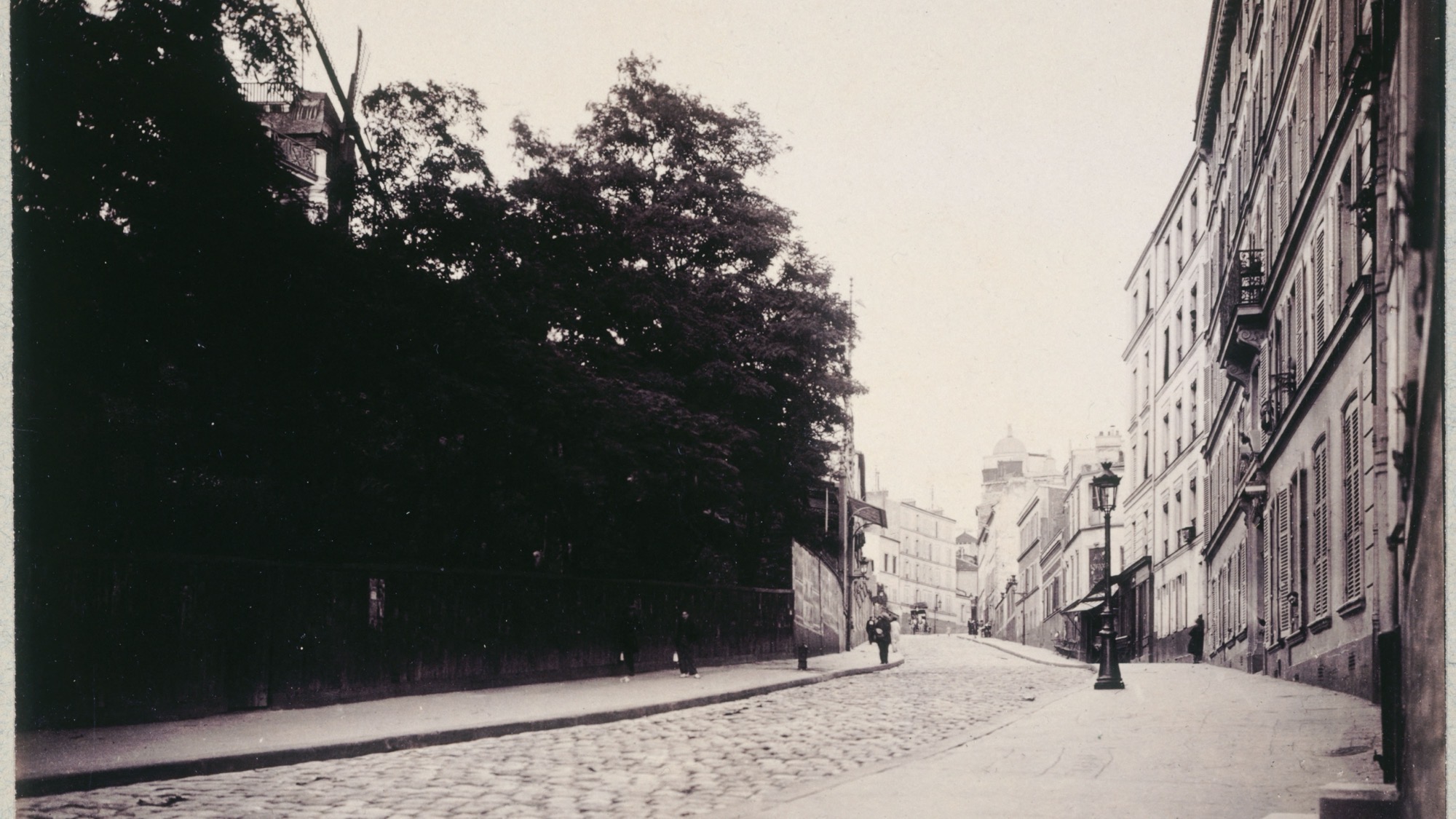
People come to Montmartre for the painters and leave with a postcard. Which is a shame, because the thousand years before them are more interesting than the half-century everyone remembers.
Where the name comes from
Two explanations sit side by side, and nobody settles it.
The first is mons Martis, the mount of Mars: in Gallo-Roman times temples to Mars and Mercury are said to have stood where the church of Saint-Pierre stands now.
The second is mons Martyrum, the mount of the martyrs, after Saint Denis, beheaded on the hill with his companions Rusticus and Eleutherius. That reading takes hold around the ninth century.
Substituting a Christian meaning for a pagan one is a convenient hypothesis, which may be why it has lasted.
A thousand years of abbey
The church of Saint-Pierre goes back to the sixth century, is first mentioned in 850, and was sacked by the Normans during the siege of 885. It is one of the oldest churches in Paris, and most visitors walk past without going in, pulled onward by the Sacré-Cœur next door.
In 1133, King Louis VI and his wife Adélaïde de Savoie founded the royal abbey of the Ladies of Montmartre. It first stood at the summit, then the nuns moved halfway down the slope, to what became known as the lower abbey.
The abbey owned the hill, and it organised life there: the crops, the vines, the mills. The Revolution ended that. The nuns were expelled in 1790 and the estate sold as national property in 1794.
The hill that was sold off by the cartload
Montmartre is made of gypsum, the stone that plaster comes from. In the early nineteenth century the former abbey land was quarried on a large scale.
The hill was dug out and sold. The plaster from these quarries went into building the Paris spreading out below. Which is to say that part of the city's housing stock is made of Montmartre.
The consequences lasted. The quarries of the lower abbey were backfilled around 1820, and rue Yvonne-Le-Tac and the extension of rue des Martyrs were laid out on top. Those halfway up were filled around 1840 for a housing development: rue des Trois-Frères, rue Berthe, rue Gabrielle, rue Drevet and rue Chappe all stand on that fill.
In between, the abandoned galleries served as a refuge for thieves and vagrants, which gave the hill a reputation it took a long time to shake off.
The vineyard, the real one
Vines are recorded at Montmartre as early as 944. In the twelfth century it is the nuns of the abbey who plant them. By the eighteenth century, three quarters of the hill is under vine.
Then it all goes. By 1928 nothing is left.
In 1930 a building scheme threatens the last open plot. Residents mobilise, the scheme fails, and the land is declared unbuildable. Three years later, in 1933, the City of Paris plants the Clos-Montmartre there: twenty thousand gamay and pinot noir vines brought from the Thomery estate, on fifteen ares. The first harvest festival is held in 1934, with President Albert Lebrun in attendance.
The vineyard is still there, on rue des Saules. It now holds some thirty grape varieties, is picked in mid-October, and produced 1,950 kilos in 2016. The wine goes to auction and the proceeds to local charities. It is not a great wine, it is a survival, and it stands up on its own.
The annexed village
Until 1860 Montmartre is not Paris. It is a commune of the Seine department, with 36,450 inhabitants recorded in 1856, its millers, its quarrymen and its taverns, where people climbed up to drink because the wine escaped the city's duty.
In 1860 Paris annexed it. The commune vanished, a small part went to Saint-Ouen, and the hill became the 18th arrondissement.
Only after that do the painters move in, drawn by low rents in a district the city has just swallowed. The Montmartre of the postcards is the last chapter, not the first.
What is left to see
The church of Saint-Pierre de Montmartre, beside place du Tertre, for its reused columns and for a silence you no longer expect in this quarter.
The Clos-Montmartre vineyard on rue des Saules, visible from the street all year round.
The Moulin de la Galette on rue Lepic, the last standing witness of the hill of the millers.
And the slope itself: the stairs, the turning streets, the abrupt changes of level. That is not picturesque, it is what remains of a hill that was quarried for a very long time.