 Akila Apart City
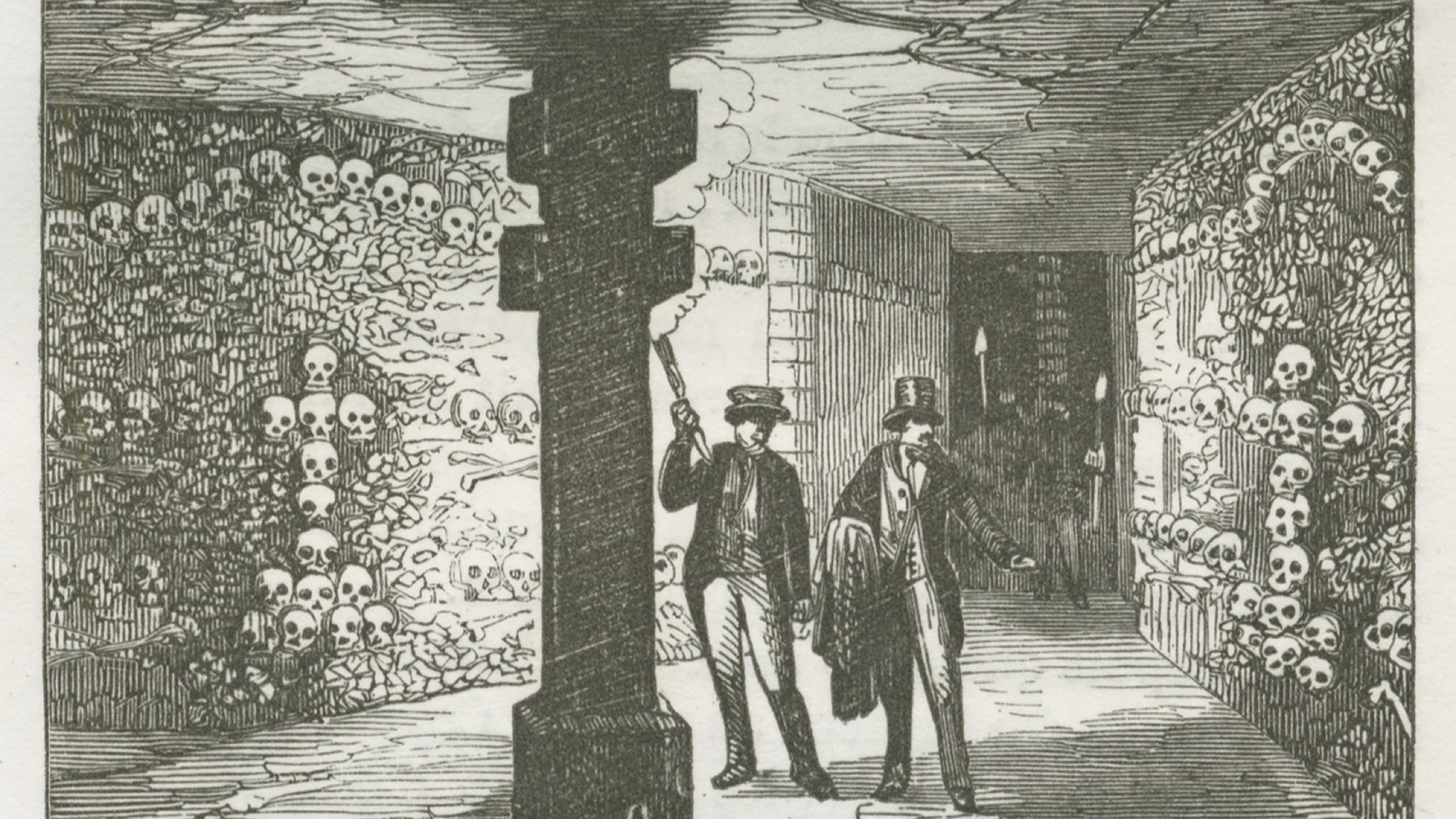
The monuments of the Latin Quarter are built of limestone, and that limestone comes from below. Paris was built by hollowing itself out, and the void it left under its streets became, first by accident and then by decision, the largest ossuary in Europe.
A city that digs into itself
The ground beneath the Left Bank is Lutetian limestone, soft to cut and hardening in the open air. Since antiquity it has been quarried here to build above. The workings run under the Montrouge plain, under Vaugirard, under the montagne Sainte-Geneviève, following the seam with no overall plan.
For centuries this happened outside the walls, in open fields. Then the city grew, caught up with its own quarries, and began building on top of its own voids. On 4 April 1777, after a series of collapses, Louis XVI created the General Quarry Inspectorate, charged with mapping and shoring up the labyrinth. It then extended, according to the official catacombs site, over some eight hundred hectares.
That department still exists. It, and not luck, is why Paris does not subside.
The cemetery that overflowed
At the same moment the city had another problem, this one above ground. The cemetery of the Saints-Innocents, beside Les Halles, had been burying Parisians for close to ten centuries on a plot that had never grown. The ground had risen several metres above the street. The common graves were overflowing, neighbouring cellars were breached, and the air of the quarter was judged dangerous.
The cemetery was closed in 1780. What remained was to decide where to put its contents.
The answer lay underground: the old Tombe-Issoire quarries, under the Montrouge plain, then outside Paris. On 7 April 1786 they were blessed and consecrated. They became the municipal ossuary.
Seventy-five years of convoys
The first transfers took place from 1785 to 1787, at night, in covered carts followed by priests. The bones of the Saints-Innocents went down first, then those of the parish cemeteries: Saint-Eustache, Saint-Nicolas-des-Champs, the Bernardins convent. This continued until 1814.
Then it resumed: in 1840, and again in 1859 and 1860, when Haussmann's new avenues tore open whole districts and whatever lay beneath had to be moved. The last deposit of bones dates from 1860.
The number of people whose remains rest there is often given as six million. The official site does not confirm that figure, and there is no register: what was carried down was bones, not individuals.
The man who arranged the bones
At first the bones were simply tipped in. It was a dump, not a monument.
Then a quarry inspector, Héricart de Thury, decided to make it something else. He had the tibias and skulls stacked into regular walls, opened walkways, set up inscriptions, and placed plaques recording which cemetery and which year each section came from. The result is an architecture made of what is left of people.
The ossuary opened to visitors from 1809, by appointment, candle in hand. The site now receives close to 550,000 visitors a year, and since 2019 the entrance is through the restored Ledoux pavilion on place Denfert-Rochereau.
What to know before going
The route open to the public is a tiny fraction of the network. All the rest is forbidden, and dangerous: unshored galleries, flooded in places, with no landmarks and no air. Clandestine descents happen, and sometimes end badly.
The official visit has a spiral staircase down and another back up. The temperature is cool and constant all year, whatever the weather outside. Bring a layer even in August, and shoes that grip: the floor is damp and uneven.
Booking online is strongly advised. The number of people allowed in at once is limited, and the queue without a ticket can be long out on the square.
The quarries elsewhere in the quarter
The ossuary is only one use among many of what lies below. The same quarries have served as mushroom farms, as cellars, as shelters during the Second World War, and as a clandestine network of passages.
At street level the clearest sign of all this is the roads that dip for no visible reason, and the buildings whose foundations run far deeper than they should. Walking from place Denfert-Rochereau towards the Panthéon, you pass over a void that nobody has ever mapped in full.