 Akila Apart City
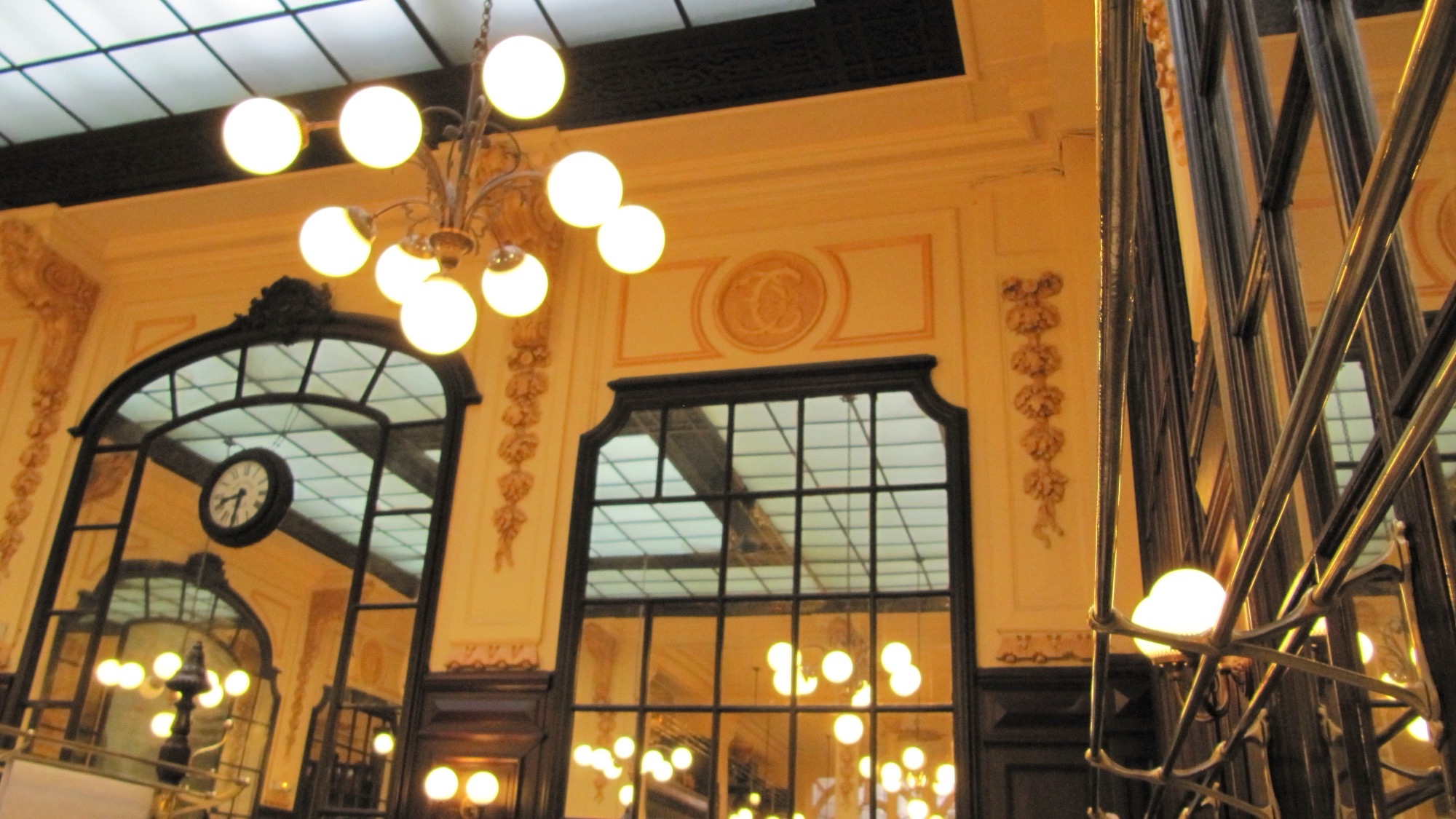
The bouillon is the first chain of popular restaurants in history, and it is a Paris invention. What survives is not a reconstruction: these are the original rooms, with their mirrors, their hat racks and their waiters still writing the order on the paper tablecloth.
A butcher with a stock problem
In 1854 Adolphe-Baptiste Duval, a butcher at Les Halles, opened an establishment of a new kind. The idea began as a question of logistics: what to do with the cuts that sell badly.
The answer was a meat broth and a dish, served fast, in a clean room, for under two francs. The intended customers were the people of Les Halles: working people with little time and little money, who nonetheless did not want to eat badly.
That is roughly the opposite of the restaurant of the day, which was expensive, slow and exclusive. The success was immediate.
His son Alexandre industrialised the formula. The Bouillon-Duval company was listed on the stock exchange, and by about 1900 it ran close to two hundred and fifty establishments in Paris. It was the first popular restaurant chain in the world.
Chartier, 1896
Others followed. In 1896 the brothers Frédéric and Camille Chartier opened a room at 7 rue du Faubourg-Montmartre that is still there, and that has served more than fifty million meals.
It has been a listed historic monument since 1989. Glass roof, woodwork, mirrors, brass hat racks, and the pigeonholes where regulars kept their napkins. You do not book, you queue, you share a table with strangers, and the waiter writes the order on the tablecloth.
None of this is added folklore: it is how the place has always worked, never abandoned because it worked.
The other rooms still standing
Bouillon Racine, 3 rue Racine, opened in 1906 by Camille Chartier. It is the only one in the Latin Quarter, ten minutes on foot from the Panthéon. Art nouveau façade and dining room, and the handsomest of the four if judged on decor alone.
Bouillon Julien, 16 rue du Faubourg-Saint-Denis. Run by the Chartiers from around 1905 until 1938. Its Art nouveau interior has been listed since 1997.
Chartier Montparnasse, 59 boulevard du Montparnasse, opened in 1903 by Édouard Chartier. Art nouveau interior listed since 1984. It passed to other owners after 1923 and became Bouillon Chartier again in 2019.
And a fourth address, opened in 2022 opposite the Gare de l'Est on rue du 8-Mai-1945. That one is new, but it follows the same rule.
Worth noting too is the Brasserie Vagenende, 142 boulevard Saint-Germain, a former Chartier of 1902 sold in 1920, whose interior has been listed since 1975.
Going without getting it wrong
The historic bouillons take no bookings, deliberately. The queue moves fast, because the service is quick and nobody lingers.
Prices have stayed the founding principle: a starter and a main for what a starter costs elsewhere. Service is included, as everywhere in France, and the change counted out on the tablecloth is part of the ritual.
Avoid eight o'clock on a Saturday, when the wait can pass an hour. Go at lunchtime on a weekday, or at half past six, when the room is barely filling and you can actually look at it.
And do look at it: the ceilings, the bevelled mirrors, the painted table numbers. Along with the metro, it is one of the few places where the Paris of 1900 still works exactly as it was designed to.